
Important Update for Costa Rica Companies, Corporations, and LLCs (Sociedades Anónimas and SRLs)
A significant legislative proposal is moving quickly through Costa Rica’s Legislative Assembly that could dramatically simplify how corporations register their official email address for legal notifications.
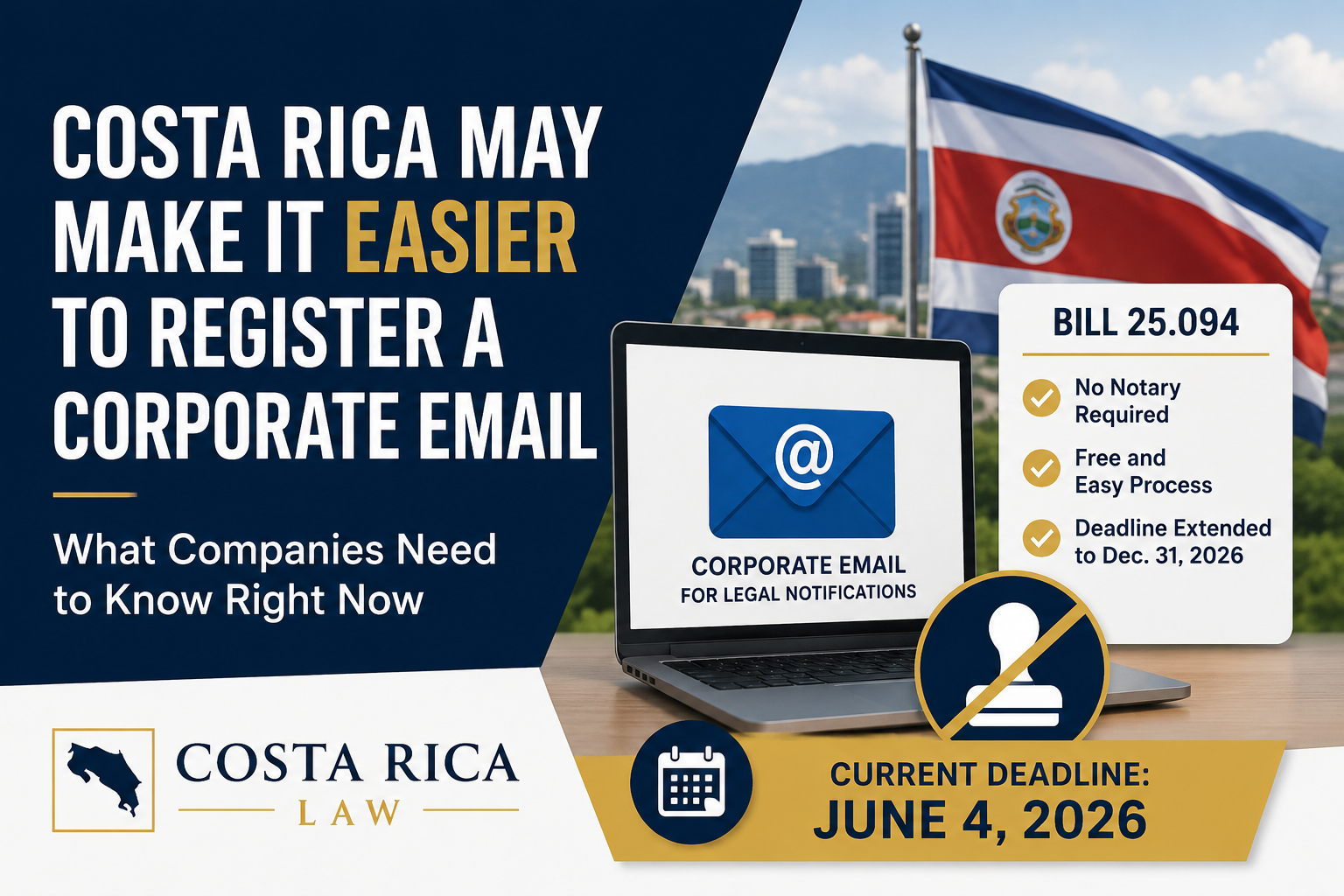
If approved, the reform would eliminate the need for a notarial public deed in many cases and extend the current compliance deadline.
However, as of today, this is still only a proposed bill—not yet law.
That means the current deadline remains June 4, 2026, unless and until the new legislation is officially approved and published.
What Is the Current Requirement?
Under Costa Rica’s existing corporate law, legal entities such as:
- Sociedades Anónimas (S.A.)
- Sociedades de Responsabilidad Limitada (S.R.L.)
- Other registered mercantile entities
must register an official email address with the National Registry (Registro Nacional) for receipt of legal notifications.
This obligation was established under Law No. 10,597, and failure to comply may expose companies to administrative complications, including difficulties receiving official notices.
Currently, the process generally requires intervention by a Costa Rican notary public to formalize the registration or amendment.
The present deadline for existing companies is June 4, 2026.
The Proposed Legislative Reform (Bill No. 25.094)
A new legislative proposal, Bill No. 25.094, titled:
“Modificación del Código de Comercio y de la Ley 10.597, para garantizar el registro gratuito y expedito del correo electrónico societario”
would significantly simplify this process.
The proposal introduces three major changes:
1. No More Notary Requirement for Email Registration
The most important change is that the legal representative of a company would be able to register or modify the corporate email address by simply filing a sworn declaration (declaración jurada).
This could be done either:
- In person at the National Registry with a handwritten signature, OR
- Electronically using a Costa Rican digital signature.
The proposed language specifically states that the process would be completed:
- Without a public deed
- Without notarization
- Without protocolization
- Without stamps or edicts
- Without intervention by a notary public
This would substantially reduce cost, paperwork, and delays.
2. Deadline Extension to December 31, 2026
The bill would also amend the transitional deadline.
Instead of the current June 4, 2026 deadline, companies would have until: December 31, 2026
to comply.
This extension would provide welcome relief to thousands of companies that have not yet completed the process.
3. Free Registration Mechanism
The National Registry would be required to provide a free mechanism allowing legal representatives to complete the filing.
This is intended to eliminate legal costs associated with mandatory notarial intervention.
Why Is This Happening?
Many businesses, lawyers, and corporate owners have criticized the current process as unnecessarily bureaucratic and expensive for what is essentially an administrative update.
The legislative reform appears intended to:
- Reduce compliance costs
- Simplify corporate administration
- Improve access to legal compliance
- Reduce congestion in the notarial system
- Encourage faster compliance by companies
Should Companies Wait?
That depends on your risk tolerance.
Option 1: Comply Now
Best for:
- Companies needing certainty
- Transactions currently in progress
- Companies with pending registry filings
- Businesses that cannot risk missing the deadline
Advantage:
- Guaranteed compliance under current law.
Disadvantage:
- Higher legal cost.
Option 2: Wait for Legislative Approval
Best for:
- Low-urgency companies
- Owners willing to monitor legislative developments closely
Advantage:
- Potentially simpler and free filing.
Disadvantage:
- If approval is delayed or fails, the June 4 deadline remains.


