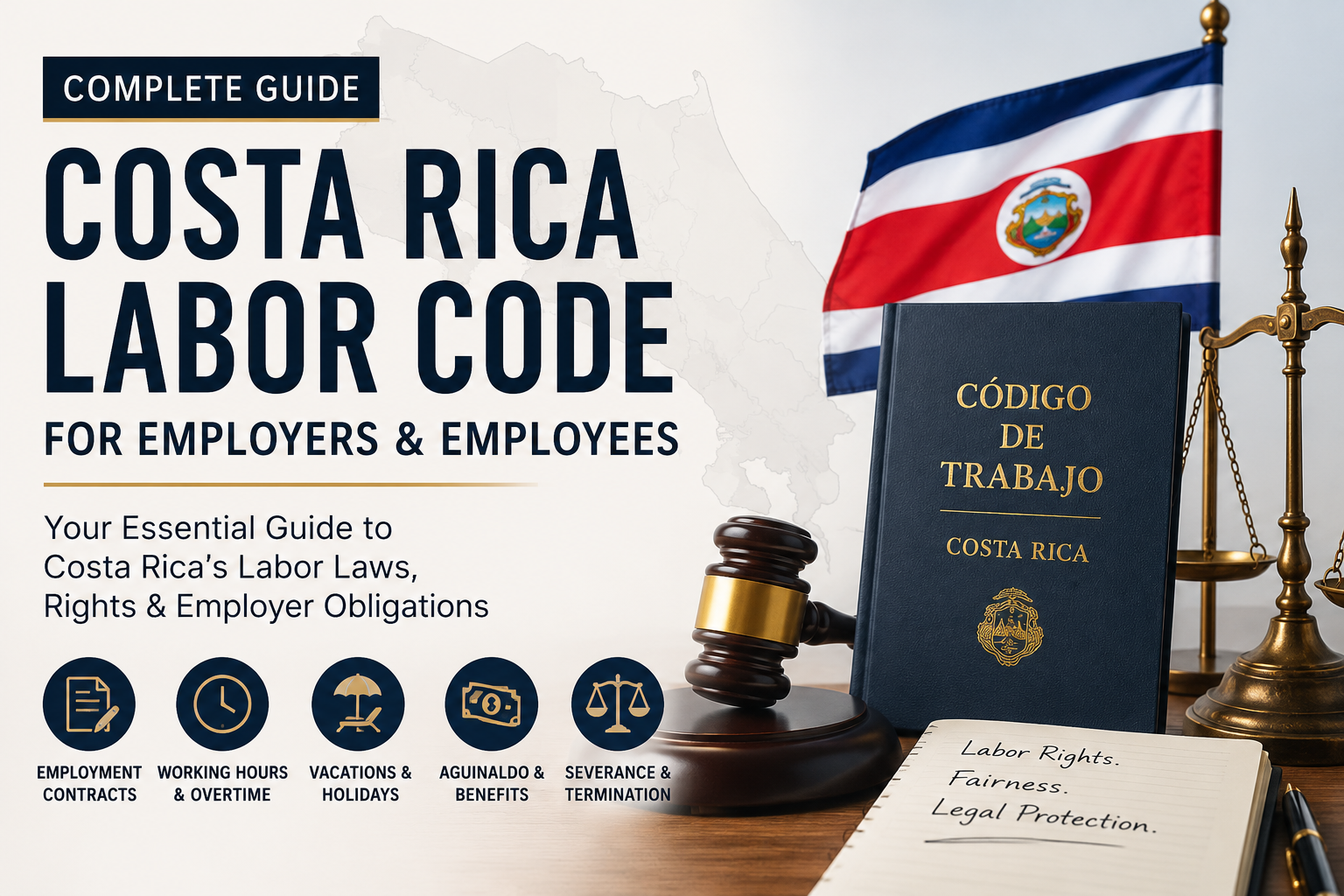
Costa Rica has one of the most employee-protective labor systems in Latin America. The country’s labor laws are primarily governed by the Costa Rica Labor Code (Código de Trabajo), originally enacted in 1943 and subsequently amended numerous times to strengthen worker protections, regulate employment relationships, and establish employer obligations.
Whether you are a foreign investor, business owner, employer, human resources professional, expat, or employee, understanding Costa Rican labor law is essential. Failure to comply with labor regulations can expose employers to significant liability, including severance claims, unpaid benefits, labor court judgments, fines, and social security penalties.
One of the defining principles of Costa Rican labor law is the principle of “In Dubio Pro Operario”—when a labor law provision is ambiguous, courts generally interpret the law in favor of the employee. As a result, employers should exercise caution when making employment decisions and ensure that their practices comply with both the Labor Code and applicable judicial interpretations.
What Is the Costa Rica Labor Code?
The Costa Rica Labor Code (Código de Trabajo) is the primary body of legislation governing employment relationships in Costa Rica. It establishes rules concerning:
Employment contracts
Employee rights and obligations
Employer obligations
Wages and compensation
Working hours
Overtime
Vacations
Aguinaldo (Christmas bonus)
Occupational health and safety
Labor unions
Collective bargaining
Termination of employment
Severance benefits
Labor court procedures
The Labor Code applies to most private-sector employment relationships within Costa Rica.
Official Sources of Costa Rican Labor Law
Employers and employees should always consult the current version of the Labor Code as amended.
Official Costa Rican Government Sources
Sistema Costarricense de Información Jurídica (SCIJ)
Because labor laws are periodically amended, readers should verify that they are consulting the most recent version of the law.
The Structure of the Costa Rica Labor Code
The Labor Code is organized into various Titles (Títulos), each addressing a specific area of labor law.
Title I – General Provisions
This section establishes the basic principles of labor law in Costa Rica, including:
Scope of labor law
Definitions of employer and employee
Employment relationships
Public policy nature of labor rights
A fundamental concept introduced in this section is that labor rights are generally considered mandatory and cannot be waived by employees
Title II – Individual Employment Contracts
This section regulates:
Employment contracts
Verbal contracts
Written contracts
Fixed-term contracts
Indefinite contracts
Probationary periods
Employer obligations
Employee obligations
Title III – Working Conditions
This section governs:
Working hours
Overtime
Rest periods
Weekly days off
Holidays
Night shifts
Mixed shifts
Typical Maximum Working Hours
Day Shift
8 hours per day
48 hours per week
Night Shift
6 hours per day
36 hours per week
Mixed Shift
7 hours per day
42 hours per week
Overtime generally must be compensated at 150% of the regular hourly wage.
Title IV – Wages and Compensation
This section regulates:
Salary payments
Minimum wage requirements
Methods of payment
Deductions
Wage protection
Costa Rica establishes minimum wages through periodic decrees issued by the government.
Employers should ensure that all employees receive at least the applicable minimum wage for their occupation.
Title V – Employee Benefits
Among the most important employee benefits are:
Vacation Pay
Employees generally earn:
Two weeks of paid vacation
After every fifty weeks of continuous service
Aguinaldo (Christmas Bonus)
The Aguinaldo is a mandatory annual bonus generally paid in December.
The bonus is calculated based upon the employee’s earnings during the applicable period established by law.
Paid Holidays
Costa Rican law recognizes several mandatory holidays that may require premium pay when worked.
Title VI – Occupational Health and Safety
Employers have a legal obligation to provide a safe workplace.
Requirements include:
Workplace safety measures
Risk prevention
Occupational accident reporting
Compliance with labor safety regulations
Employers must also maintain Workers’ Compensation coverage through the National Insurance Institute (INS).
Title VII – Labor Unions and Collective Rights
This section regulates:
Labor unions
Collective bargaining agreements
Workers’ associations
Collective labor rights
Employees generally have the right to organize and participate in labor organizations.
Title VIII – Special Employment Relationships
The Labor Code contains special provisions applicable to:
Domestic workers
Agricultural workers
Apprentices
Certain categories of specialized workers
Foreign employers frequently encounter these provisions when employing domestic staff such as housekeepers, caretakers, gardeners, drivers, and cooks.
Title IX – Labor Disputes
This section establishes procedures for resolving labor disputes through:
Administrative proceedings
Labor courts
Judicial claims
Employees may file claims for:
Unpaid wages
Overtime
Vacation pay
Aguinaldo
Severance benefits
Wrongful termination
Title X – Labor Court Procedures
Costa Rica has specialized labor courts that handle employment-related disputes.
Labor judges have broad authority to:
Order reinstatement
Award unpaid compensation
Impose penalties
Enforce employee rights
Recent procedural reforms have significantly modernized labor litigation procedures.
Title XI – Final and Transitional Provisions
This section addresses:
Implementation rules
Regulatory authority
Transitional provisions
Related legal matters
The Most Common Labor Law Issues Faced by Employers
1. Misclassification of Employees
Many businesses incorrectly classify workers as independent contractors when they legally qualify as employees.
Courts analyze factors such as:
Control
Supervision
Work schedule
Exclusivity
Economic dependence
Misclassification can result in significant liabilities.
2. Improper Termination Procedures
One of the most expensive mistakes employers make is terminating employees without properly documenting performance issues or disciplinary violations.
Employers should seek legal advice before terminating employees under circumstances that may be contested.
3. Overtime Claims
Improper recordkeeping frequently leads to overtime disputes.
Employers should maintain:
Time records
Attendance logs
Payroll documentation
4. Vacation and Aguinaldo Calculations
Many labor claims arise from incorrect calculations involving:
Vacation accrual
Vacation payouts
Aguinaldo calculations
5. Severance (Cesantía) Liability
Employees terminated without just cause are generally entitled to severance benefits. Depending upon the circumstances, employers may also owe:
Pre-notice (Preaviso)
Vacation balance
Aguinaldo
Other accrued compensation
Termination of Employment in Costa Rica
Employment may end through:
Resignation
Employees generally receive:
Vacation balance
Aguinaldo
But typically not severance.
Dismissal With Cause
Employees generally receive:
Vacation balance
Aguinaldo
But typically do not receive severance or pre-notice.
Dismissal Without Cause
Employees may be entitled to:
Severance (Cesantía)
Pre-notice (Preaviso)
Vacation balance
Aguinaldo
Retirement
Calculate Severance Online
To estimate severance obligations under Costa Rican labor law, use our free:
Costa Rica Labor Severance Calculator
The calculator provides estimates for:
Cesantía (Severance)
Preaviso (Pre-Notice)
Vacation Balance
Aguinaldo
Total Termination Liability
This tool can help both employers and employees better understand potential labor obligations before making employment decisions.
Need to Calculate Labor Severance in Costa Rica?
Use our Costa Rica Labor Severance Calculator to estimate severance pay, pre-notice, vacation balance, and proportional Christmas bonus based on Costa Rican labor law.